Thursday, February 28, 2013

Aerospace Engineering Course

Engineers checking a get engine, (GAA, 2013)


The reason why I am studying in the United Kingdom is that my aerospace engineering course is not available at my home country of Bahrain. Some universities have just started to dedicate aerospace engineering courses. According to Ameinfo.com (2012) Bahrain has become the second HND provider for aerospace engineering in the Middle-East. However, these initial achievement does not seem to be strong enough to persuade students that are hoping to study BEng to apply for lower degree. This forces students that are hoping to study this course to travel abroad to somewhere that offer more prestigious courses.


There are not well-developed courses for aerospace engineering simply because there is no aviation industry in the country neither in the middle-east. The thriving commercial aviation in the middle-east requires huge amount of technicians that keep maintaining aircrafts but not to design new ones  BAS (2011) announced that "Our certifying staff and qualified mechanics perform inspections, routine and non routine checks, snag rectification, cabin maintenance...". Nevertheless, there is still a little demand for engineers for managing and planning the process of aircraft maintenance.


At the end, I would absolutely wish if there were sophisticated aerospace engineering courses in Bahrain. If this was the case I would not sustain the long distances away from my home and family. Also, it would be drastically useful for the economic of Bahrain to bring in this pioneering industry of aviation.


Bibliography


Ameinfo.com (2012) BAETC first in Bahrain to offer aeronautical engineering 'Edexcel HND' qualification. Available at: http://www.ameinfo.com/287469.html (Accessed: 28 February 2012).


BAS (2011) Aircraft Engineering Services. Available at: http://www.bas.com.bh/Pages.aspx?id=S3fls72kWao= (Accessed: 28 February 2012).


GAA (2013) Engineers Checking a Jet Engine [Online] Available at: http://gaa.aero/default.asp?action=category&id=52 (Accessed: 28 February 2012).


Thursday, February 14, 2013

Interesting traditions in the UK

Every person around the entire world has a distinguished culture. Many people when hear the world of culture they may automatically think about traditions, customs, food and art. However, culture can be defined as common patterns, behaviours and understanding that people acquire through socializing. This blog will address notable traditions in the UK. 


Throughout my settlement in the United Kingdom I have noticed many interesting traditions. The Bonfire Night, for example, one of them. The Bonfire Night coincides the 5th November when all people of England celebrate every year. The celebration is to burn a dull the represents the character of Guy Fawkes that his plot is to blow up the house of parliament about 400 years ago. Unfortunately, the plot was foiled when Guy Fawkes was arrested and tortured to death. Since, it became one of the popular traditions in the UK, BBC (2013). 


Figueiredo (2013)


One of the strange traditions is that the Pancake. Education Scotland ( 2013) says that “Pancake Day is the day before Ash Wednesday, the first day of Lent. It is celebrated throughout the UK by the cooking and eating of pancakes.” I did not know this day until the English family that I was living with last year served me one. 


At the end, there are other interesting traditions but these two amazed me more. If you’re planning to come over you have not miss these two days and I am sure you will like them. 


Bibliography


BBC (2013) Guy Fawkes. Available at: http://www.bbc.co.uk/history/people/guy_fawkes (Accessed: 14 February 2013). 


Education Scotland (2013) Shrove Tuesday (Pancake Day) - 12 February 2013. Available at: http://www.educationscotland.gov.uk/resources/s/shrovetuesday.asp (Accessed: 14 February 2013).


Figueiredo, P. (2013) [Online]. Available at: http://www.educationscotland.gov.uk/resources/s/shrovetuesday.asp (Accessed: 14 February 2013 ).

Wednesday, February 13, 2013

Popular Sports in the UK

The United Kingdom is so popular in many sport games. When the talk is about sport, the first thing may come across your mind is football that England is so popular for. However, there are many interesting traditional and modern sport games that are spread out all over the country. 


Football is one of the most popular sports in the UK, and it is the national sport of England where the most famous clubs come from such as Manchester United, Liverpool and Arsenal. The reason why football is so popular in England more than other countries is that the game originated there, (FIFA, 2013). 


Alongside Football, there are many other sports such as rugby. It might be the second popular game in the UK after football. Here, Wales is the home of rugby that is the national game of Wales. According to Guardian (2003), rugby began in 1823 when the 16 year old boy, William Webb Ellis ignored the rules of Football and picked up the ball and ran with it. Since it became popular and spreaded to different parts of the UK. 


In conclusion, sport games are numerous in the United Kingdom, but Football and rugby seem to drastically have huge audiences not only in the UK but also in many parts of the world. They have this popularity because of the enjoyable and interesting rules of playing. 


Bibliography


FIFA (2013) The History of Football. Available at: http://www.fifa.com/classicfootball/history/game/historygame1.html (Accessed: 13 February 2013).


Guardian (2003) A brief history of rugby. Available at: http://www.guardian.co.uk/sport/2003/oct/06/rugbyworldcup2003.rugbyunion6 (Accessed: 13 February 2013).

Thursday, February 7, 2013

Urdu Community in the UK

It is observed that Urdu community has become one of the biggest in the United Kingdom. Generally, Urdu is the official language in Pakistan that is spoken by more than 100 million people, according to Edwards (2007). 


Urdu speakers are distributed all over the UK, but they are mounting in the capital London, the northern textile towns and the West Midlands, Edwards (2007). Urdu community first appeared when Pakistanis immigration to Britain started in early 17th century, BBC (2003).


One interesting fact is that the first book in Urdu is called Sabras translated from Persian and was written in 1635-36 by Mullah Asadullah Wajhi. Also, the first book printed using a printing press that was brought from india by Portuguese was Bagh-o-bahar by Mir Amman, published in 1801, BBC (2013).


Urdu community has added much to the culture of the United Kingdom, they also contributed in the British sport. BBC (2008) stated that “Amir Khan's contribution to British boxing has taken him to national and global recognition and he was nominated BBC Sports Personality of 2005.” Beside the Pakistani and Indian food that is very common nowadays throughout the UK.


Bibliography


BBC (2003) The Pakistani Community. Available at: http://www.bbc.co.uk/gloucestershire/untold_stories/asian/pakistani_community.shtml (Accessed: 7 February 2013).


BBC (2008) Pakistani London. Available at: http://www.bbc.co.uk/london/content/articles/2005/05/26/pakistan_london_feature.shtml (Accessed: 7 February 2013).


BBC (2013) A Guide to Urdu - 10 facts about the Urdu language. Available at: http://www.bbc.co.uk/languages/other/urdu/guide/facts.shtml (Accessed: 7 February 2013).


Edwards, V. (2007) Your Voice: Urdu. Available at: http://www.bbc.co.uk/voices/multilingual/urdu.shtml (Accessed at: 7 February 2013).


Thursday, January 24, 2013

Newspaper Comparison

Nowadays, the media has many methods of reporting news to the public. Newspaper has been one of the best to deliver a wide range of local and international affairs. As usual, there appear to be some newspaper that have more proficiency than others. This blog will compare a newspaper with a tabloid in several aspects.


Aspects of Comparison
The Telegraph
Mirror
Language
The author used a set of formal vocabulary such as:
“Cost of a child hits record £222,000”, “…raising a child…”, “…nursery care…”.

The author often used informal vocabulary and phrasal verbs throughout the article such as: “The cost has rocketed to £222,000…”, “...bring up…”, “…darling…”, “…babysitting…”.
Content details
More detailed information and estimations about the in the future. Examples: “… this is set to reach £350,000 by 2023 if costs continue to increase…”, “…London (£239,123), the South East (£237,233) and the East of England (£233,363) have remained the three most expensive places to raise children.”
The text is quite short and concise. Basic information are included. Example:  “… £19,270 feeding one child and £16,195 on holidays…”, “The most expensive area to raise children is still London at £239,123.”
References used in the article
Supported by three references are used. Two are in-text and one is a direct quote.

“…LV='s annual Cost of a Child Report show that…”

“According to LV=, more than four…”

“…said Mark Jones, head of protection at LV=”
<!--[if !supportLineBreakNewLine]-->
<!--[endif]-->
Supported by two references are used. One is in-text and one as a direct quote.

“…according to the Cost of a Child report.”

“Mark Jones, for LV=, said…”
Visual images
One large focused picture of a child and his mother kissing him is displayed for the main topic.
One large picture for different ethnicities of children.


Bibliography


Gammell, K. (2013) ‘Cost of a child hits record £222,000’, The Telegraph, 24 January [Online]. Available at: http://www.telegraph.co.uk/finance/personalfinance/consumertips/household-bills/9823143/Cost-of-raising-a-child-hits-record-222000.html (Accessed: 24 January 2013).

Sayid, Ruki. (2013) ‘Baby boom: Cost of raising a child rockets by 58% in a decade’, Mirror, 24 January [Online]. Available at: http://www.mirror.co.uk/money/personal-finance/cost-of-a-child-report-222000-to-bring-1552229 (Accessed: 24 January 2013).


Crime & Punishment

1) Should the death penalty exist as a punishment for murder or terrorism?
In the past, the authority of justice was extremely tough. There was either a life sentence or an execution. Nowadays, regime has changed to have some of tolerance, and human rights organisations have appeared to fight these extreme verdicts. " Amnesty International opposes the death penalty in all cases without exception regardless of the nature of the crime, the characteristics of the offender, or the method used by the state to kill the prisoner." (Amnesty, 2011).

2) Should the main purpose of prison be punishment or rehabilitation?
Detaining criminals in a prison and freeing them after they serve their sentences would not change much in their behaviours. Accordingly, Modern prisons are heading toward schemes to rehabilitate the prisoners and prepare them to be freed the community. A ministry of Justice spokeswoman (cited in the Huffington Post, 2012) stated that the prisons are presence to protect the community, and to punish and rehabilitate prisoners thus they are less likely to commit crime.

 
3) What is the best way to deal with juvenile crime such as joy-riding, Vandalism and graffiti?

Regarding joy-riding, in my home country of Bahrain its sentence has some tolerance. It is dealt with by fine and delaying the date of the driving test for 6 months. When it relates to vandalism and graffiti, their sentences are much strict. They may be a fine or serving one to two months in prison.

4) Is it ever right for political activists to break the law?

As the political activists are there to reform the government policies, it does not make sense if they break the law. But sometimes they beak laws that they think they are not fair and they need to be changed.


5) How strict should the law be with people who drink and drive?

Although, these people often cause accedents, in most countries they are only fined a small amount of money. Authorities should treat them accordingly to their criminal registery, also to how dangirous their driving is.


6) Which is the more serious problem in your country – tax evasion or social security fraud?

The social security fraud appears to bethe most common in my country. Usually who commits this kind of crime face low income problem. Therefor, the authorities are trying to trace these people that could be fined or prisoned.

 
7) Should the police have the right to stop and search you in the street without a warrant?

The duty of police is to keep order in street. Hence, if there is no mystry in the behaviour of the drivers behaviour they should disrupt them.


8) Should the law respect the rights of homeless people to squat in unoccupied property or shop doorways?

The state is responsible of providing shelter for its people. So if there are people still have nowhere to go the law should respect thier condition.


9) Should smoking cannabis be a criminal offence?

Cannabis is a kind of pisones that is harmful for human being, and more dangerous than smoking tobbaco.


Bibliography

Amnesty International (2011) Abolish the death penalty. Avilable at: http://www.amnesty.org/en/death-penalty (Accessed at: 24 January 2013).

Huffington Post (2012) ‘Prison Overcrowding Undermining Rehabilitation, Says Report’, The Huffington Post, 6 March [Online]. Available at: http://www.huffingtonpost.co.uk/2012/03/05/prison-overcrowding-rehabilitation_n_1322339.html (Accessed at: 24 January 2013).


Thursday, January 10, 2013

London Riots 2011

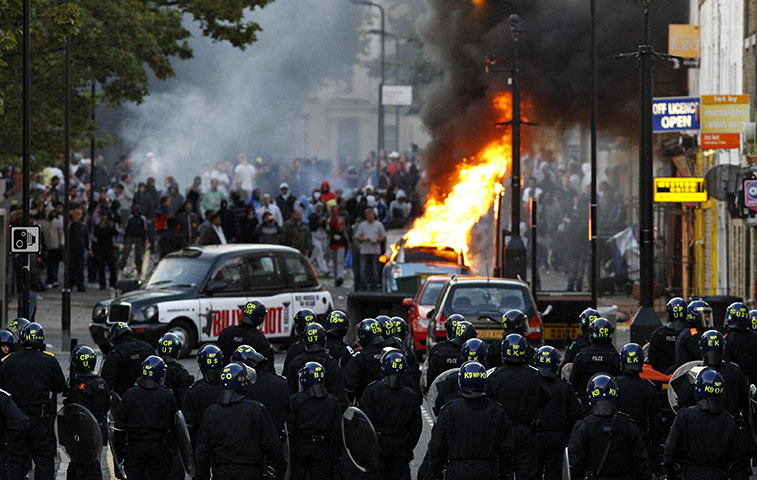
Police officers in riot gear block a road near a burning car in Hackney (Macgregor, 2011)


Following Arab Spring in 2011, there were many peaceful demonstrations in London. These protest soon turned into riots and violence. I first knew about it when I was reading BBC News. There were many photographs of young men published online were clashing with police. Petrol bombs were intensively used from the rioters’ side, and in contrast police fired teargas canisters. The violence was dominating the scene all over the capital. As a result, many were arrested, injured and many shops were closed and ruined.


According to BBC News (2011) the riots erupted on 6th August over a death of unarmed man who was shot by police, since, the violence commuted to famous cities around England such as Tottenham, Birmingham and Manchester. The incentives beyond the riots appear to be more than shooting unarmed man. Generally, Those who took part in fight with police were almost young men reportedly come from poor communities, and they are unemployed (CBC News, 2011). Penny (cited on the CBC News website, 2011) claimed that "The truth is that very few people know why this is happening."

Authorities reaction to riots was to restore order and peace, and not to allow terror emerges on Britain’s streets. Thus, enormous number of troops intervened to deter rioter from vandalizing public and privet properties. Police arrested many and promised to bring them to justice.


Bibliography


BBC (2011) England riots: Maps and timeline. Available at: http://www.bbc.co.uk/news/uk-14436499 (Accessed: 10 January 2013).

CBC News (2011) Getting to the root of the U.K. riots. Available at: http://www.cbc.ca/news/world/story/2011/08/09/f-uk-riots-faq.html (Accessed: 10 January 2013).

Macgregor, L. (2011) Police officers in riot gear block a road near a burning car in Hackney [Online]. Available at: http://www.guardian.co.uk/uk/gallery/2011/aug/09/london-riots-croydon-hackney#/?picture=377701208&index=16 (Accessed: 10 January 2013).